Thursday, April 7, 2011

Rock Songs of Epic Length

There are songs that get radio airplay because they are justifiably awesome. And there are songs that are just as awesome, but rarely get played on the radio because they are of freaking immense length. Here are some of those songs that you'll never hear before 11 PM, will never be released as a single, but are inarguably totally rad.

(Note: Because there are some bands that do these long songs really, really well (coughPROGROCK/cough), I have a few with tons and tons of examples of this. For brevity's sake, I'll highlight just one song per band, then include the other long songs underneath.)

(Note II: For my purposes, a "long" song is something over seven minutes' duration. I will break this rule several times, but if it's close to the edge, I'll allow it. Hyuk hyuk.)

(Note III: Some of these songs do, in fact, get radio play. Dressing it up just allows me to feel like I'm fighting The Man in some way, the notion of which is of course essential to rock music.)

Let's Kick This Pig!

In (more or less) increasing order of time:

Iron Maiden, "Phantom of the Opera", 7:06
Not as well known as "The Trooper" or "Run to the Hills", this song still features an incredible guitar solo to open things up, and the rest of the song keeps up the pace. Well worth a listen.

Nightwish, "Meadows of Heaven", 7:10
The conclusion to semi-concept album Dark Passion Play, "Meadows of Heaven" starts out slow but builds irresistably to an inspired, and rather heartbreaking, finish. The sound of new-to-Nightwish singer Annette Olzen belting out the title over a choir, guitars and a male singer at the end is really striking; one suspects that they wanted to show off her vocal range and let fans know that it was comparable, if not equal, to ex-singer Tarja Turunen's. Other long songs from Nightwish include "7 Days to the Wolves" (7:10), "The Poet and the Pendulum", a 13:55 rock epic that opens DPP, and the incomparable "Ghost Love Score" (10:02) that highlights their album Once. (+12 Lord of the Rings bonus on that last link!)

Kansas, "Hopelessly Human", 7:18
"Hopelessly Human", along with "Closet Chronicles" (6:32), came off of Point of Know Return, my favorite Kansas album and also the only one I know at all. Actually, you know what, how about this. "Human" is a bonus song, but if you only listen to one of these, pick "Closet Chronicles." In fact, here you go.
There. Listen to that. It's fantastic. I would go so far as to call that song one of the best stories ever told through rock music. That final "I heard the king was dying! I heard the king was dead!" is just incomparable.

King Crimson, "21st Century Schizoid Man", 7:27
If there is such a thing as postmodern rock, "21st Century Schizoid Man" is probably what it sounds like. With very few lyrics (and those almost impossible to understand) and most of the piece taken up by a fat instrumental in the middle (coupled with a fantastic bass line), the song is basically one long dystopian scream at whatever poor bastard might have irritated the band on that particular day. This ain't exactly music to fall asleep to; listen at your peril.

We're going to skip over Genesis and come back at "Supper's Ready", so in the meantime...

Metallica, "The Call of Ktulu", 8:53
The last track on Metallica's best album, Ride the Lightning, "The Call of Ktulu" is also one of their very few instrumentals. Slow, ominous and menacing are the watchwords of this song, and damn if the band doesn't deliver on them. Also worth checking out from Metallica are "Fade to Black" (6:57), "One" (7:27), of course "Master of Puppets" (8:35) and the always disorienting "Orion" (8:28). Note: If you go and find the music video for "One", prepare to be creeped the fuck out. You've been warned.

Guns'n'Roses, "November Rain", 8:57
As far as I'm concerned, "November Rain" marks the ultimate sad power ballad in rock. Everyone else can give up and go home. It's over after this.
Same goes for the following video, "You Could Be Mine" (5:44, yes I'm breaking my own rule on account of awesome). Terminator 2: Judgment Day meets Guns 'n' Roses?! How can you possibly hope to top that? By the way, Arnold Schwarzenegger actually appears in the video for this song, the only time (to my knowledge) that a Hollywood star has descended to the level of music videos.
Other notables include "Civil War" (7:42) and their cover of the Rolling Stones' "Sympathy for the Devil" (7:36).

Ayreon, "The New Migrator", 8:17 
I write something about "The New Migrator" pretty much any time I write anything related to music, at all, ever, so a lot of description probably isn't necessary. Suffice to say that you don't have to follow the Ayreon mythology (of which there is PLENTY) to enjoy this song. The entire song is one of Arjen Lucassen's absolute best. It flummoxes me every time I hear it. If you like prog rock, you've found some of the best with this song.
Other Ayreon songs include "The Garden of Emotions" (9:41) and "Amazing Flight" (10:15) off Into the Electric Castle. And if you really must (sigh), go ahead and look up "The Fifth Extinction" (10:29) or even "The Sixth Extinction" (12:19) off of 01011001.

Lynyrd Skynyrd, "Free Bird", 9:06
Yeah, you know this one.

Yes, "Yours Is No Disgrace", 9:41
The masters of the prog-rock epic, Yes's The Yes Album produced technically stunning songs like this, as well as "Starship Trooper" (9:25), "Perpetual Change" (8:54) and "I've Seen All Good People" (6:57). The list of excellent long songs they wrote is impossible to tabulate, so I'll just leave you with "Roundabout" (8:29) and their sweeping "Close to the Edge: The Solid Time of Change/Total Mass Retain/I Get Up", a song that is even longer than its title at a massive 18:41. It's so long, in fact, that that was only part 1; part 2 must be sought out here.

Ensiferum, "Victory Song", 10:42
I don't go in for Norse Viking metal. Okay, well not that much. Okay, well...
Regardless of that, however, you have to admit that "Victory Song" is the epitome of triumphant Norse metal.
Ensiferum has also put out songs like "Lai Lai Hei" (7:15) and the hilariously subversive "Stone Cold Metal" (7:25), a song so wacky that I wrote an entire note about it back in the day (Read: The Bronze Age, aka last semester).

Rush, "Xanadu", 11:05
For some reason I can't get the stupid video to embed itself in the page. So, having embedded my computer in the wall, I now invite you to listen to the studio recording of the song here. A freaky video but a wonderful song, "Xanadu" is second only to "Closet Chronicles" in telling a compelling story through a rock song, and takes a back seat to nobody when it comes to instrumentation. Here is the live version.
This is off of what I consider to be Rush's best album, A Farewell to Kings. Also coming from that album was the rather creepy "Cygnus X-1" (10:25), which is about a ship getting sucked into a black hole. Setting this song as an alarm to wake up to in the morning produced a hilariously surreal experience. Don't try it.

Genesis, "Supper's Ready", 22:53
The giant of long songs, Genesis produced this gem at the end of Foxtrot. I was only able to find this (full) video on YouTube, which also includes the introduction that Peter Gabriel would give before shows. Yes, it's weird. Yes, the song is phenomenally weird, as well as divided into seven parts so it's really more of a musical suite. Yes, it's absolutely worth your attention, if you've got forever or so to listen.
Genesis were absolute masters of the great long song. Along with "Supper's Ready", Foxtrot alone produced "Get 'Em Out by Friday" (8:37) and "Watcher of the Skies" (7:23). Nursery Cryme gave us "The Musical Box" (10:32), the hilarious "Return of the Giant Hogweed" (8:12) and "The Fountain of Salmacis" (7:35), while Selling England By the Pound had "Firth of Fifth" (9:38) and "Dancing with the Moonlit Knight" (8:04). Other songs, of which there are many, included Trespass's "The Knife" (8:56).

Whew! Like that didn't take a couple of hours to put together. I hope you enjoyed at least some of these songs, which are guaranteed to cross the lines of musical taste (as well as good taste)! I'll now be off for food-taste.

Ta-ta!


-Andy


 These lovely ladies are known as Värttinä.

Wednesday, April 6, 2011

Robot Guitar Birds: Best Idea Ever

It is my humble, profound and considered opinion that someone should invent robot birds to sit outside your window in the morning and play the sounds of electric guitars. Chirping? Forget that. Robot birds (R) can offer you a much improved wake-up experience, and even act as an alarm clock! And the complimentary jet propulsion system means you'll never again be late for class; just set the timer, code in your DNA signature and it'll find you anyplace in the city to wake you up and get you ready!

What could be better than hearing this song outside your window to rouse you from your slumber?

(The bird also comes with a titanium shield to fend off the rocks and other objects your neighbors will hurl at it.)

Just $199.99 now from Impractical Robots! No shipping and handling fee--just contact us and the bird will make its maiden flight right to your windowsill!

Operators are standing by!

Sunday, April 3, 2011

The (Newly Announced) Literary Theory of the Eye

What is sight? What is vision? We can talk about the rod cells and cone cells that line the backs of our eyes, the intricate workings of the optic nerve and the layers of the cornea and the beauty of the iris, but if we reduce the issue of the eye to mere science, the knowledge that we may gain from a philosophical and literary critic’s perspective may be lost.

Let us begin by discussing our background. Literary critics from Sasseure to Foucault have deconstructed the meaning of the words we use to describe the things, people and places around us and that we inhabit. Sausseure broke down the substance of language into the signified and the signifier, the word we speak out loud or type on a page or sign with our hands versus the concept we are attempting to refer to by these words. Other critics have examined the role of the book versus an Internet document or a magazine, the role of language in shaping the words we use, and even how our environment determines our personalities, selves and/or our very thoughts

But to my knowledge, nobody has yet discussed the importance of the eye in vision and in comprehending all of this literary hoopla.

I would like to call for the opening of a Foucauldian discourse about the nature of the eye and vision in comprehending literary works. Do blind people reading Foucault understand him in a different way than those who can actually see the words on his pages? What exactly is the different reaction that a play inspires when it is actually being viewed, and experienced with all the senses, instead of merely the eye's seeing it in a book or on a television screen? And what, above all, does this mean to literary theory?

I await the scholars' reactions.

(This is intended to be a joke, but I'm sure that somewhere out there, a theorist is concocting or has already concocted his or her own completely serious theory of the eye. And as spectacularly stupid as this is, there are probably literary or philosophical lines of inquiry that are much worse.)

Friday, April 1, 2011

Packers Draft Trends

After six drafts and one Super Bowl championship, I think that Packers general manager Ted Thompson has amassed a fair enough body of work that we can try and draw some conclusions. I'm going to present the draftees, point out some trends and see if I can make some tentative predictions about his 2011 draft from a positional standpoint. (All hail Wikipedia!) If you're a Packers fan and/or already know this stuff, feel free to skip the following lists.

2005
1. Aaron Rodgers, QB (Pro Bowl)
2. Nick Collins, FS (Pro Bowl)
2. Terrence Murphy, WR (retired; spinal stenosis)
4. Marviel Underwood, CB (out of NFL, defined here as 1+ years without being on a NFL team)
4. Brady Poppinga, OLB
5. Junius Coston, C (out of NFL)
5. Mike Hawkins, CB (out of NFL)
6. Mike Montgomery, DE (free agent)
6. Craig Bragg, WR (out of NFL)
7. Kurt Campbell, CB (out of NFL)
7. Will Whitticker, G (out of NFL)

2006
1. A.J. Hawk, LB
2. Daryn Colledge, G
2. Greg Jennings, WR (Pro Bowl)
3. Abdul Hodge, LB (Carolina)
3. Jason Spitz, G-C
4. Cory Rodgers, WR (out of NFL)
4. Will Blackmon, CB (free agent)
5. Ingle Martin, QB (out of NFL)
5. Tony Moll, T (Baltimore)
6. Johnny Jolly, DT (suspended)
6. Tyrone Culver, S (Miami)
7. Dave Tollefson, DE (NY Giants)
(Signed Tramon Williams, UFA)

2007
1. Justin Harrell, DT
2. Brandon Jackson, RB
3. James Jones, WR
3. Aaron Rouse, S (Omaha Nighthawks; played for Cardinals in 2010)
4. Allen Barbre, G (Miami)
5. David Clowney, WR (Carolina)
6. Korey Hall, LB/FB
6. Desmond Bishop, LB
6. Mason Crosby, K
7. DeShawn Wynn, RB (New Orleans)
7. Clark Harris, TE (Cincinnati)

2008
2. Jordy Nelson, WR
2. Brian Brohm, QB (Buffalo)
2. Patrick Lee, CB
3. Jermichael Finley, TE
4. Jeremy Thompson, DE (retired, spinal stenosis)
4. Josh Sitton, G
5. Breno Giacomini, T (Seattle)
7. Matt Flynn, QB
7. Brett Swain, WR

2009
1. B.J. Raji, DT/NT
1. Clay Matthews, OLB (Pro Bowl)
4. T. J. Lang, G/T
5. Quinn Johnson, FB
5. Jamon Meredith, OT (Buffalo)
6. Jarius Wynn, DE
6. Brandon Underwood, CB
7. Brad Jones, LB

2010
1. Bryan Bulaga, T
2. Mike Neal, DE
3. Morgan Burnett, S
5. Andrew Quarless, TE
5. Marshall Newhouse, C/G
6. James Starks, RB
7. C.J. Wilson, DE

33 of Thompson's 58 drafted players remain on the Packers' roster or IR list. Two were forced to retire due to medical conditions, eight are out of the NFL, eleven are on the rosters of other NFL teams (Aaron Rouse is on a UFL team), two are free agents and one has been suspended from the league. Just two players (Johnny Jolly, Brandon Underwood) have had legal trouble in the past six years, a testament to the character of the players Thompson has drafted. Four of his draftees (Aaron Rodgers, Greg Jennings, Nick Collins, Clay Matthews) have been selected to at least one Pro Bowl, along with two free agents (Charles Woodson, Tramon Williams).

Players Selected by Position

Players are arranged in descending order of their contributions to the team.

QBs: 4 (Rodgers, Flynn, Martin/Brohm)

WRs: 8 (Jennings, Nelson, Jones, Clowney, Swain, Bragg/Rodgers/Murphy)
RBs: 3 (Jackson, Starks, Wynn)
TEs: 3 (Finley, Quarless, Harris)
FBs: 2 (Hall, Johnson)
OL*: 12 (Sitton, Colledge, Spitz, Bulaga, Lang, Moll, Newhouse/Coston/Whitticker/Barbre/Giacomini/Meredith)
CB: 6 (Lee, Blackmon, B. Underwood, M. Underwood/Hawkins/Campbell)
S: 4 (Collins, Rouse, Burnett, Culver)
ILB: 2 (Bishop, Hodge)
OLB: 4 (Matthews, Hawk, Poppinga, Jones)
DL: 9 (Raji, Jolly, Neal, Wilson, Wynn, Montgomery, Tollefson, Harrell, Thompson)
K: 1 (Crosby)

*(Since many of Thompson's O-line and D-line draftees have played several positions, this seems like the most hassle-free way to do the list.)

Thompson has selected just three running backs (Jackson 2nd, Wynn 7th, Starks 6th). He likes to aim high for WRs, having spent second-round picks on Murphy, Jennings and Nelson and a third on Jones.  Craig Bragg (6th), Cory Rodgers (4th), David Clowney (5th) and Brett Swain (7th) round out the crew at WR, the most players Thompson has selected at any single position.

Thompson selected three cornerbacks in his first-ever draft, all of whom failed. Perhaps discouraged, he took a total of three in the next five drafts, preferring instead to find CBs on the street (Williams, Shields) or through free agency (Woodson).

Until 2008, Thompson had a reputation for only trading down in the draft. That year he traded up to get Jeremy Thompson in the fourth round, and has done it each year since, nabbing Clay Matthews in 2009 and Morgan Burnett in '10. Thompson has made only two player-for-player trades that I can recall, shipping Tony Moll to Baltimore in 2009 for Derrick Martin and swapping Samkon Gado for Vernand Morency. He also famously acquired Ryan Grant from the Giants for a sixth-round pick. 

Thompson likes to go after offensive linemen in the middle rounds of the draft, spending picks on Sitton, Lang, Moll, Giacomini, Coston, Barbre and Meredith in rounds 4-6. Of these, only Sitton and Lang appear to have stuck.

Thompson has piled up a lot of late-round picks over the years, by way of compensatory picks or trades, which is one reason why the Packers average 9.6 selections per year. The Packers have had 28 picks in the last six years in the fifth, sixth and seventh rounds. From these rounds have come five starters (Bishop, Crosby, Hall, Jones, Jolly) and three talented backups (Flynn, Wilson, Starks) who are likely to start at some point. Bishop is probably the single best player from these rounds, closely followed by Flynn.

While Thompson hasn't regularly found talent at the bottom of the draft, at the top he's been outstanding. Only one of his first-round picks has been a bust (Harrell), with every other one starting and two making trips to the Pro Bowl. Rodgers, Jennings, Collins, Matthews, Raji and Finley are top-five players in the entire league at their respective positions, and Neal, Burnett, Colledge, Jackson, Jones, Nelson and Spitz have either been decent starters or excelled as backups. Tally them up and you can say that Thompson has had success with 13 of his top 21 picks, which is a figure most GMs would kill to have.

Players Selected by Round
(Chronological order)

1. Rodgers, Hawk, Harrell, Raji, Matthews, Bulaga
2. Collins, Murphy, Colledge, Jennings, Jackson, Nelson, Brohm, Lee, Neal
3. Hodge, Spitz, Jones, Rouse, Finley, Burnett
4. Underwood, Poppinga, Rodgers, Blackmon, Barbre, Sitton, Lang
5. Coston, Hawkins, Martin, Moll, Clowney, Giacomini, Johnson, Meredith, Quarless, Newhouse
6. Montgomery, Bragg, Jolly, Culver, Hall, Bishop, Crosby, Wynn, Underwood, Starks
7. Campbell, Whitticker, Tollefson, Wynn, Harris, Flynn, Swain, Jones, Wilson

Finally, Thompson has shown a tendency to defy the draftniks who label teams' biggest needs and how they should be addressed. He passed on selecting a cornerback or an outside linebacker in the 2010 draft, ignoring pundits' judgment that that was the team's biggest need. What happened? Super Bowl.

With that said, I offer my tentative conclusion that Thompson will go wide receiver, offensive tackle or defensive end in the first round. He will likely address at least two of these positions during the first three rounds of the draft. With an incredibly deep roster already in place, don't be surprised to see Thompson make a trade to get into the second round again to snag a favored player.

With the Packers' first-round pick I'd like to see him take any of these players, all of whom have been available at #32 in some of the mock drafts I've seen: RB Mark Ingram, WR Jonathan Baldwin, OT Benjamin Ijalena, DE J.J. Watt, OLB Akeem Ayers, DE Jabaal Sheard, G Danny Watkins, G-C Mike Pouncey or DE Cameron Heyward.

Thursday, March 31, 2011

Science Textbooks are Bullshit

Let me tell you a little story about my time at Wooster. I've taken three science classes, which were indisputably the sort of watered-down stuff that's suitable for liberal-arts majors, so let it be clear that I'm not speaking of textbooks for the people who're actually majoring in it. These are the sort of overview textbooks that you're supposed to get for 100- and 120-level classes, and they are worthless.

The story goes like this. My freshman year, I took Geology of Natural Hazards, which is a 105 class. The textbook cost $128. I used it about a dozen times in the first week. After that? Not at all. We didn't refer to it in class and we didn't need it for the class. I ended up selling it back for $55, which at a loss of $73 was still the best price I could get, and getting a B+ in the class.

Next year's class, History of Life (Geo-100) wasn't as bad, but I still shelled out $40 for the Encyclopedia of Earth and used it only a handful of times. Grade: A.

This year, I decided I'd had enough of this shit, and declined to purchase the textbook for my Astronomy of Stars & Galaxies course. That would've set me back anywhere between $60 and $80. I initially planned to make it up by periodically pilfering my friend Tadd's book, but after the first week I didn't even bother with that.

Results? The final grade isn't in yet, but I'm sitting pretty with two test scores of 92.8% and 103.3%.

My empirical study with limited sample size has shown me...

WEAK SCIENCE TEXTBOOKS ARE BULLSHIT.

Thank you and good night.

Wednesday, March 30, 2011

My Top Six Webcomics (Not Named XKCD)

XKCD is the undisputed king of webcomics, both in content and popularity. We know this. However, there are approximately six kajillion other webcomics out there, and a few more that I've become quite fond of. So, in descending order, here are the top six that I've found. You'll have to excuse the slightly hipster-ish nature of this post, bit I swear to God, nobody has ever heard of some of these, including my favorite. (I get to differentiate myself from hipsters by not holding that up as a virtue!)


Webcomic #6: Sandra and Woo!

They've helpfully put together a sample for new readers. Click to expand!

Consciously inspired in part and influenced in large by Calvin & Hobbes, Sandra & Woo chronicles the adventures of a grade-school girl and her talking raccoon, as well as a coterie of her friends. The comic is a German/Indonesian collaboration between writer and artist, whose drawings are reminiscent of Japanese manga, but very technically detailed. The comic has periodic story arcs that'll last a dozen or a couple of dozen strips, which can be as lighthearted as exploring an abandoned building Final Fantasy-style, or as serious as a panegyric on human rights violations in Burma. I enjoy watching Woo (the raccoon) and his animal friends more than I do the humans in the comic, but the humans are still interesting and generally well-drawn. Woo isn't a sanitized Disney animal, either; as you can see in the first comic up above, he's frequently shown killing and eating prey. That isn't glossed over for younger readers, which I've always found appealing.
Now, it's not the greatest comic; the strip's FAQ tells us the writers have stopped focusing so much on Woo and Sandra since around fall '09, in favor of the human families of Sandra's friends, which I think is generally less interesting. That doesn't mean, however, that it isn't a very technically accomplished and very good comic.


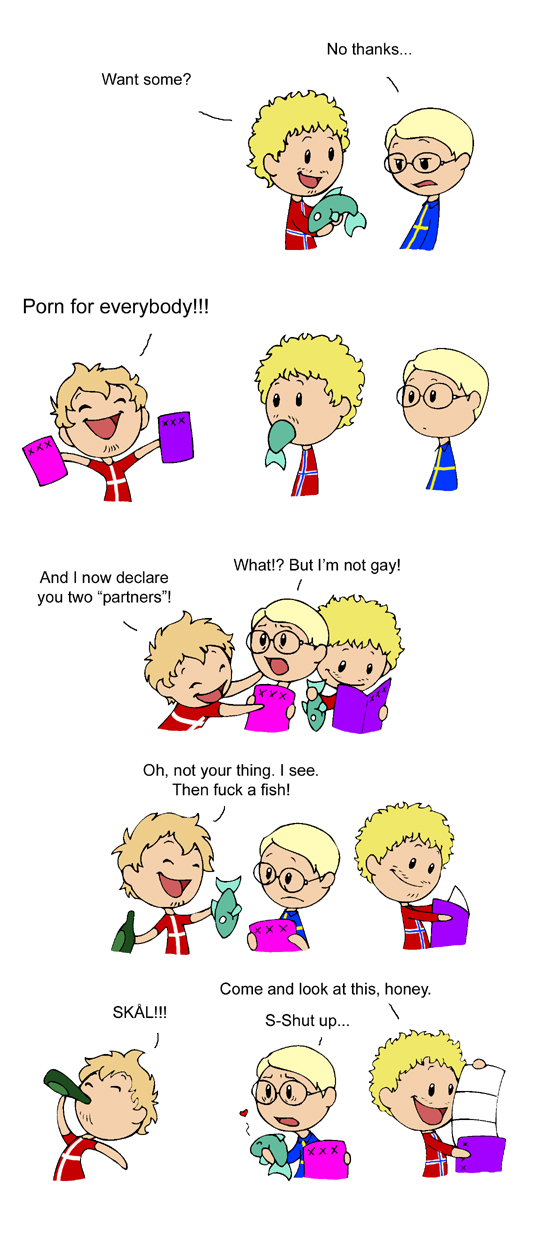
Webcomic #5: Scandinavia and the World!
I don't know a thing about Scandinavia, aside from odd tidbits that I picked up last semester from living with a Norwegian, and the fact that I cannot for the life of me spell 'Norwegian' without help from Google.
This is still funny, though. A Danish artist turned comic-strip writer created this comic, in which the characters are all personifications of countries, or rather the stereotypes of those countries. There's a lot of in-joking about Scandanavian stereotypes (the main characters are Sweden, Norway, Denmark and Finland), but Humon (the artist) always explains the jokes at the bottom of the page, which are sometimes funnier than the comic in question. The strip itself is funny, obscene at times and often devastatingly accurate in its characterizations, which aren't limited to Scandanavia. The USA frequently makes appearances as a well-meaning but immature dude (my favorite strip has him charging into Iraq while yelling "LEEEEEROOOOOYYY JENKINS!!!!!!"), and by this point most of Europe has also had cameos. The stereotypes Scandanavians apparently have about the U.S. tend to vary between puzzlingly wrong and devastatingly accurate.
By now, the strip has its own mythology, with lots of relationships between the various countries and even some children. The hilarious thing is that all of the relationships do have some bearing in either history or stereotypes. It's a little hard to keep track of if you don't know all of the various Scandanavian islands and principalities offhand, but that makes it no less fun to read.


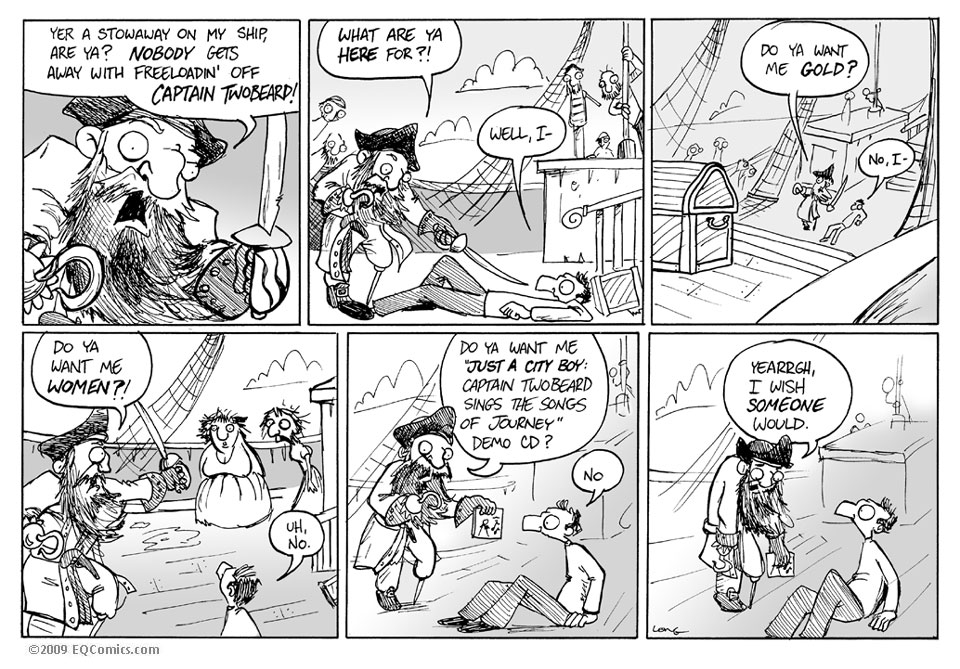
Webcomic #4: Edmund Finney's Quest to Find the Meaning of Life!
The most wonderfully unconventional of the comics, this one chronicles the travels of Edmund Finney through a fantasy world populated by aliens, pirates, time-traveling diners, giant walking eggs, talking turkeys, miniature witches, trolls that live under the streets and every other weird thing you could imagine. There's no overall storyline to the comic, which is a little saddening because it could make an excellent serial, but the various encounters Edmund has with various strangers are really funny by themselves. The comic is very well-drawn, too; artist Dan Long has a very distinctive way of drawing faces that I don't think I've seen anywhere else. He's created a world where everyone plays by different sets of really weird rules, and Edmund is the only sane person wandering through it all, trying to find the meaning of all of this. The comic is frequently critical of bits of everyday life, particularly advertising and/or the media, and can sound preachy at times. However, that's more than offset by the wonderful silliness in nearly every comic. I'd recommend this one to webcomic readers of any taste.


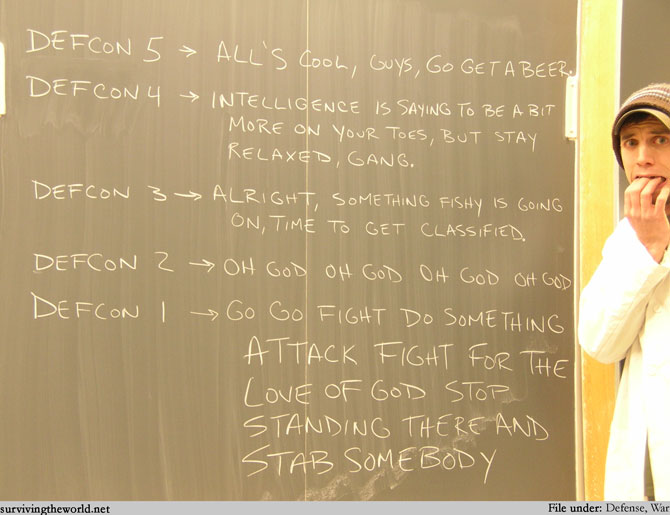
Webcomic #3: Surviving the World

STW is unique on this list in a couple different ways. First of all, it's the only photocomic I know that's worth reading, and second, it's the only webcomic anywhere (probably) that's actually taught as an accredited class at a real live university. (Sorta.)
From creator Dante Shepard, STW is exactly what it sounds like: Little bits of wisdom about and commentary on the art of getting through life.
Some of it is helpful, some of it should not be applied practically by any sane individual, but the comics are generally pretty good. It's always fun to watch Dante's face in the sidebar, too, which can be anything from scared silly (above) to massively goddamn creepy (see link in title). Published every day, and usually early, it's a great way to get your humor fix in the mornings.

(By the way, folks, here's where the hipsterism starts; both these last two are entirely obscure.)


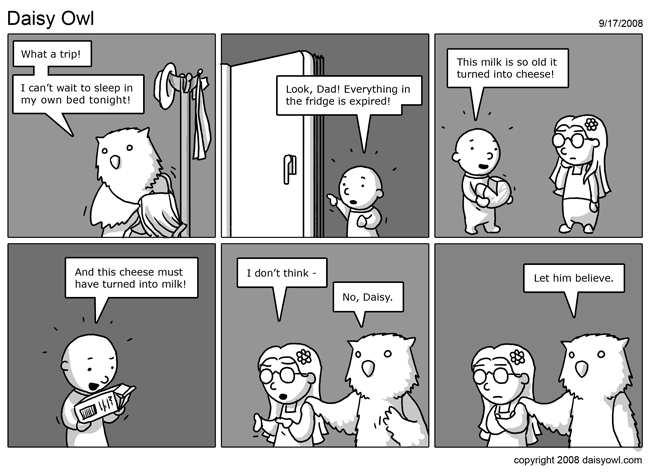
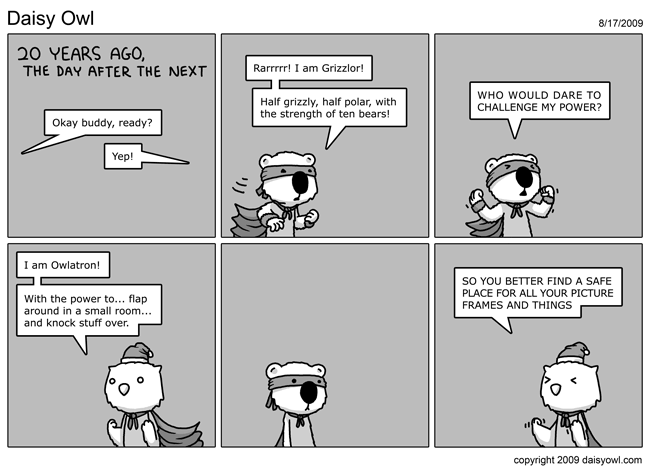
Webcomic #2: Daisy Owl

Sadly no longer running, Daisy Owl is still my second favorite webcomic because of its uniqueness. The strip didn't go for a punchline or an easy joke, preferring (much of the time) to try more offbeat humor or just plain ridiculousness. Example: The main characters are a bear, an owl and the owl's two human children. The children were originally space babies developed by the government, who were shot into orbit accidentally, crashed in Owl's backyard and were adopted by him.

The art is sporadic; most of the comics are like the one above, with no backgrounds and lots of blank space, but every so often will come along this wonderfully detailed drawing extravaganza. The humor isn't for everyone, but I found it both really funny and really endearing. Sadly, the strip started feeling forced towards the end, and it shows in the last big storyline; the artist ended up stopping Daisy Owl because he was feeling the pressure of coming up with a new gag every few days. The early and middle of Daisy Owl, though, are excellent.


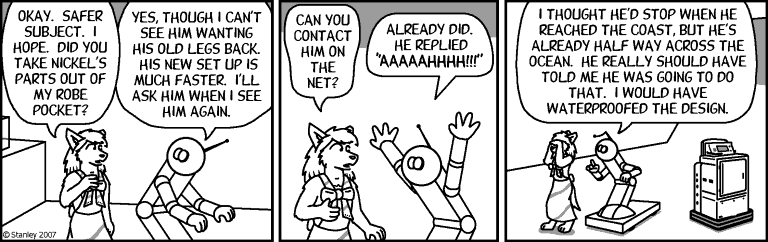
Webcomic #1: Freefall


Let me tell you a little story about how I reacted when I found Freefall. The comic has been updating every three days since 199-freaking-9, giving it a massive backlog of comics (over 2,000 right now, for those scoring at home). The day I discovered it, I read all 2,000 comics in less than 24 hours.

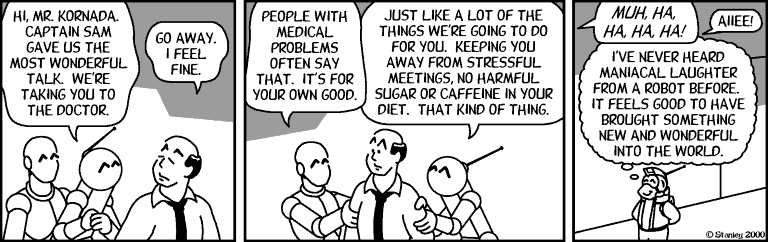
Freefall is a science-fiction webcomic, combining the best elements of hard sci-fi (no "magic" technology, just extrapolating from what we already know) with excellent, detailed characters, original ideas and complex, intricate plots. The comic takes place on a world that's in the process of being terraformed, a sort of frontier existence. Many of the main characters are robots; others include a squid-like alien, a wolf/human hybrid A.I., and the occasional human. The development of the characters themselves has been fascinating to watch, but I've never seen a comic that gets inside the heads of non-human entities as well as this one does. They have realistic goals and desires, and worldviews that aren't just a human perspective grafted onto a robot body. This comic reads like the creator really did get inside the minds of some robots and give them their own unique perspectives, which is really incredibly rare.

Now, the comic isn't perfect. Each strip covers only a fraction of a day or a conversation, and the strip attempts to mimic the lives of these characters as closely as possible. This means that in its twelfth year and its 2,000th strip, Freefall has advanced less than six months in in-comic time. Major plot threads will take a long, long time to resolve; the current plotline, which deals with stopping a robotic war, has lasted for a few months now and is still only in the exposition. Nevertheless, it's an extremely good webcomic that's hindered only by its formula, and contains dozens of distinctive and believable characters. Whether it's main characters Sam Starfall (squid), Helix (robot), Florence Ambrose (Bowman's Wolf) or recurring contributors like Qwerty, Dvorak, Sawtooth Rivergrinder, Edge, Blunt (robots) or even the occasional human (The Mayor, Mr. Konada, Winston Thurmad), every single one is a pleasure to read. I highly recommend plowing through the archives; you might be done sooner than you think possible.

Tuesday, March 29, 2011

Moondance: From The Mixed-Up Files Of...

I've had a bit of a lull in cranking out new blog posts for the past few days, for a bunch of reasons. Between being home for a few days, having a massive amount of rum cunningly concealed in Coke on Saturday night and then being still drunk/hungover for most of Sunday and fitting back into college life and work, I haven't had a lot of time or ideas for "just writing". So in lieu of that, I ask for your patience (dear readers) and present you instead with this little chunk of verbiage that I wrote sometime over winter break and has been sitting in a file on my desktop. Enjoy. Or don't, or however you please.


Moondance

The terror of the empty page is what they call it. Infinite options waiting to be shaped and formed. Dynamic whitespace, you might say. It’s as if the computer dumped a mound of blank white potential in front of me, and here I am with a potter’s wheel and a mind to make something. Only, I’m not sure I know quite how. It’s weird, really. There’s this drive, a focus, an impulse to create spurred on by the maddening chase music now playing at 2:43 AM in my room in Milwaukee, but I don’t know what to create. How can I? How can I make these words, these lifeless bits of ink and paper that are created as easily as I can drum my fingers upon the keyboard, into something with the depth and, dare I say, grit of the visions in my head? How do I mold it into a vase of my choice?

And then I realize, it’s not the description that makes hay for the writer. It’s not the carefully chosen metaphors or the sliding scale of thoughts laid out neatly for the reader. It’s the characters you’ve got to have. But making flesh into paper is nearly as hard as the reverse, and whether you’re drawing inspiration from the mad curmudgeons in your real life or the media personalities people put on and take off as needed, you still need to create something in the end. There is a face and a voice to be put to it, a personality and needs and desires. The writer’s block was never an issue with me, but knowing quite what to do and quite how is the trick, I think.

It’s like dancing in a darkened room, you know? The room of someone you don’t know all that well, and you’ve just been invited up for the first time and you’re waiting for them to come upstairs to show you where the bloody light switch is. And there’s all this junk around on the floor, a chair here and a stool there and a radio and a trunk and a glass bowl that’ll shatter if you even breathe on it. Somehow, you have to find the way between these things without falling over and breaking your face.

So you step to the left and you turn to the right, reach back two feet and grab hold of the dresser, spin in, turn about and tread on your partner’s toes, and you’re off and dancing in the night-black space! You step and then you turn, you whirl and you twist, always you’re dancing ‘round those barriers you don’t even know exist.  And it really is a dance, because even though you can’t see anything around you, somehow you always know where to put your feet. There’s a right place to be, a right time to turn, a right step to take. There’s a right word to find, always is. The tip of a brush wafting down a canvas with the greatest care, barren landscapes bursting into bloom.

That’s what finding the right word is like. Turning backward, spinning, slipping but never quite falling, always yanking yourself out at the last moment. Searching for that one thought, maddeningly elusive though it be, that will perfectly describe the idea spinning in your head. Never settling for less, secure in the knowledge that the right word is out there, somewhere, buried in the back pages of some dusty dictionary. All you have to do is find it.

"...you are my master and I LOVE you!"