In the successful, long-running webcomic Edmund Finney's Quest to Find the Meaning of Life, protagonist Edmund has met innumerable strange people. There's the Count that speaks only in literal statements, the executioner who creates an execution-themed amusement park, the dragon who's a scam artist, a homicidal elevator operator and many more. All of these people seem to be insane from the perspective of the reader and of sane, rational Edmund, who shares the reader's values and often acts as an audience surrogate. The question is, are they insane, or is he?
If we accept that insanity is a species of craziness wherein the lunatic's values/beliefs/actions are following a recognizable pattern (e.g. slamming your face into the floor five hundred times every night to ward off the invisible goblin gods)...
...and if we accept the precept that insanity (and therefore sanity) is not a fixed concept, since sanity (normal behavior) is defined by the society you're in, and therefore sanity is relative...
...and if we accept Ray Bradbury's quote, "Insanity... depends on who has who locked in what cage"...
...might it not be the case that Edmund, who appears to be the only sane, rational person in the comic from the perspective of the reader, is actually the crazy one? He appears sane to us, but in the world of the webcomic, he's the one out of step with every other character. Folk wisdom has it that if you encounter a problem at your job, and you switch jobs six times and the same problem reappears every time, you're likely to be the one with the problem. Could this apply to Edmund, who seems out of place in every situation he enters?
Sure, he seems sane to us because we share his values. Edmund Finney's defining traits are logic and rationality, traits that most of his readers sympathize with. But from the perspective of beings in Edmund's world, he's the abnormal one. Their twisted logic and crazy decisions are the norm. What we consider rationality is strange and alien. Wouldn't it make sense, then, for them to lock Edmund up?
And that's exactly what happens, actually. In one telling comic, Hand-Farmer McGann harvests a crop of hands from the ground, then runs off into the night. The police come by looking for an escaped mental patient, and Edmund (sanely and rationally) tells them that a guy claiming to farm hands just passed by. The police call off their search and take Edmund into custody. One reading of the comic is that the police arrested Edmund because he sounded crazy telling them about McGann, and they thought he was the mental patient. My argument, however, is that they arrested Edmund because he gave the rational answer. He wasn't punished for sounding crazy by our standards, but by theirs. Even if McGann had escaped from an asylum (and we see later that the asylum inmates aren't much crazier than the outside world's inmates), the police did their "sane" duty by arresting an innocent man. Everything fits.

Showing posts with label edmund finney. Show all posts
Showing posts with label edmund finney. Show all posts
Tuesday, September 20, 2011


Wednesday, March 30, 2011
My Top Six Webcomics (Not Named XKCD)
XKCD is the undisputed king of webcomics, both in content and popularity. We know this. However, there are approximately six kajillion other webcomics out there, and a few more that I've become quite fond of. So, in descending order, here are the top six that I've found. You'll have to excuse the slightly hipster-ish nature of this post, bit I swear to God, nobody has ever heard of some of these, including my favorite. (I get to differentiate myself from hipsters by not holding that up as a virtue!)
Webcomic #6: Sandra and Woo!
Consciously inspired in part and influenced in large by Calvin & Hobbes, Sandra & Woo chronicles the adventures of a grade-school girl and her talking raccoon, as well as a coterie of her friends. The comic is a German/Indonesian collaboration between writer and artist, whose drawings are reminiscent of Japanese manga, but very technically detailed. The comic has periodic story arcs that'll last a dozen or a couple of dozen strips, which can be as lighthearted as exploring an abandoned building Final Fantasy-style, or as serious as a panegyric on human rights violations in Burma. I enjoy watching Woo (the raccoon) and his animal friends more than I do the humans in the comic, but the humans are still interesting and generally well-drawn. Woo isn't a sanitized Disney animal, either; as you can see in the first comic up above, he's frequently shown killing and eating prey. That isn't glossed over for younger readers, which I've always found appealing.
Now, it's not the greatest comic; the strip's FAQ tells us the writers have stopped focusing so much on Woo and Sandra since around fall '09, in favor of the human families of Sandra's friends, which I think is generally less interesting. That doesn't mean, however, that it isn't a very technically accomplished and very good comic.
Webcomic #5: Scandinavia and the World!
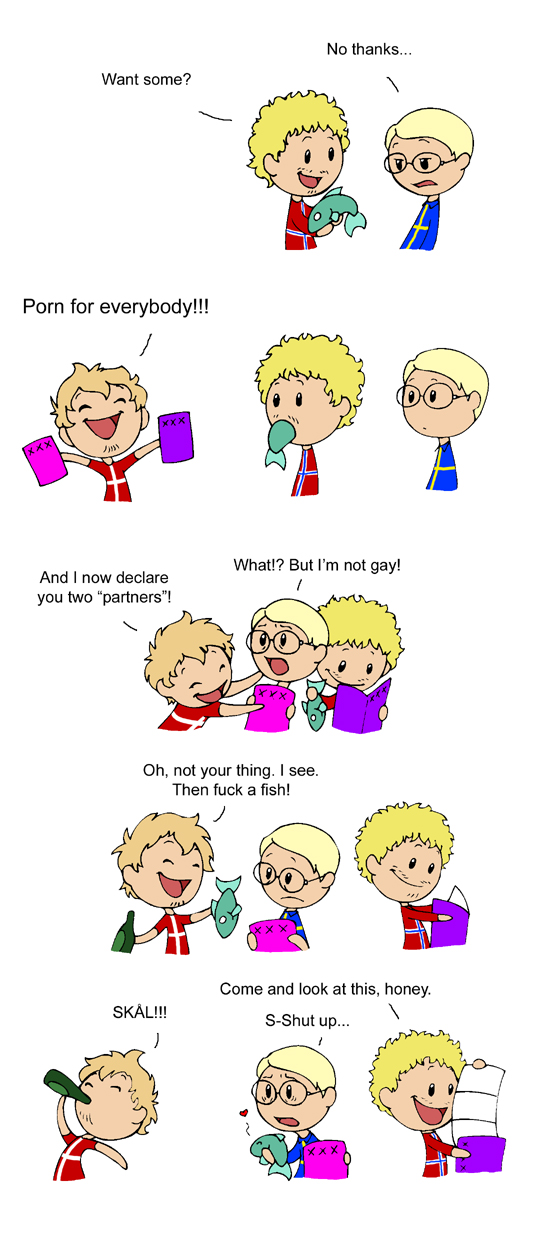 I don't know a thing about Scandinavia, aside from odd tidbits that I picked up last semester from living with a Norwegian, and the fact that I cannot for the life of me spell 'Norwegian' without help from Google.
This is still funny, though. A Danish artist turned comic-strip writer created this comic, in which the characters are all personifications of countries, or rather the stereotypes of those countries. There's a lot of in-joking about Scandanavian stereotypes (the main characters are Sweden, Norway, Denmark and Finland), but Humon (the artist) always explains the jokes at the bottom of the page, which are sometimes funnier than the comic in question. The strip itself is funny, obscene at times and often devastatingly accurate in its characterizations, which aren't limited to Scandanavia. The USA frequently makes appearances as a well-meaning but immature dude (my favorite strip has him charging into Iraq while yelling "LEEEEEROOOOOYYY JENKINS!!!!!!"), and by this point most of Europe has also had cameos. The stereotypes Scandanavians apparently have about the U.S. tend to vary between puzzlingly wrong and devastatingly accurate.
By now, the strip has its own mythology, with lots of relationships between the various countries and even some children. The hilarious thing is that all of the relationships do have some bearing in either history or stereotypes. It's a little hard to keep track of if you don't know all of the various Scandanavian islands and principalities offhand, but that makes it no less fun to read.
Webcomic #4: Edmund Finney's Quest to Find the Meaning of Life!
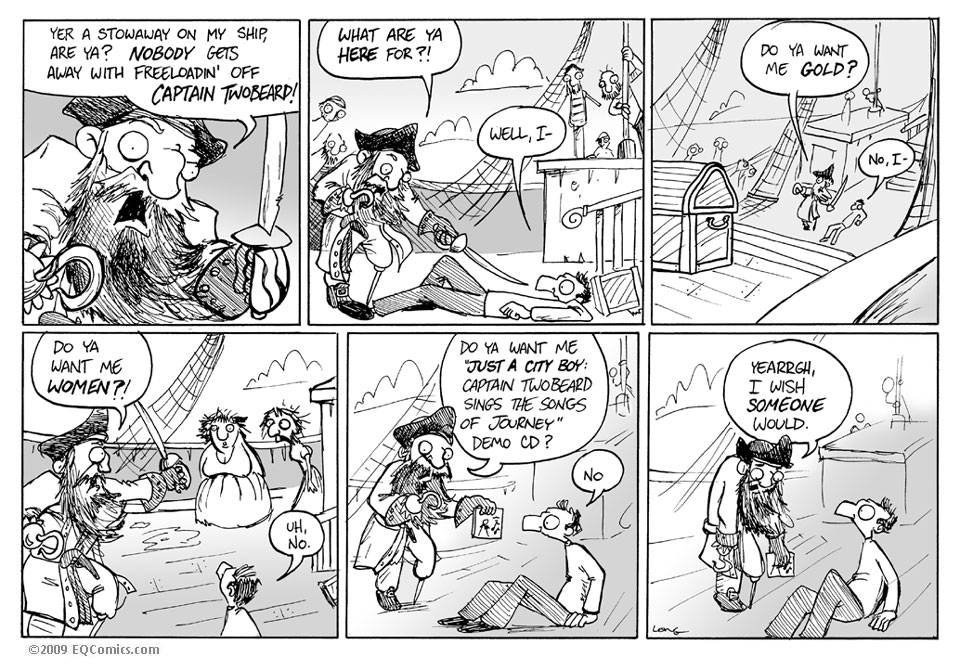 The most wonderfully unconventional of the comics, this one chronicles the travels of Edmund Finney through a fantasy world populated by aliens, pirates, time-traveling diners, giant walking eggs, talking turkeys, miniature witches, trolls that live under the streets and every other weird thing you could imagine. There's no overall storyline to the comic, which is a little saddening because it could make an excellent serial, but the various encounters Edmund has with various strangers are really funny by themselves. The comic is very well-drawn, too; artist Dan Long has a very distinctive way of drawing faces that I don't think I've seen anywhere else. He's created a world where everyone plays by different sets of really weird rules, and Edmund is the only sane person wandering through it all, trying to find the meaning of all of this. The comic is frequently critical of bits of everyday life, particularly advertising and/or the media, and can sound preachy at times. However, that's more than offset by the wonderful silliness in nearly every comic. I'd recommend this one to webcomic readers of any taste.
Webcomic #3: Surviving the World
 STW is unique on this list in a couple different ways. First of all, it's the only photocomic I know that's worth reading, and second, it's the only webcomic anywhere (probably) that's actually taught as an accredited class at a real live university. (Sorta.)
From creator Dante Shepard, STW is exactly what it sounds like: Little bits of wisdom about and commentary on the art of getting through life.
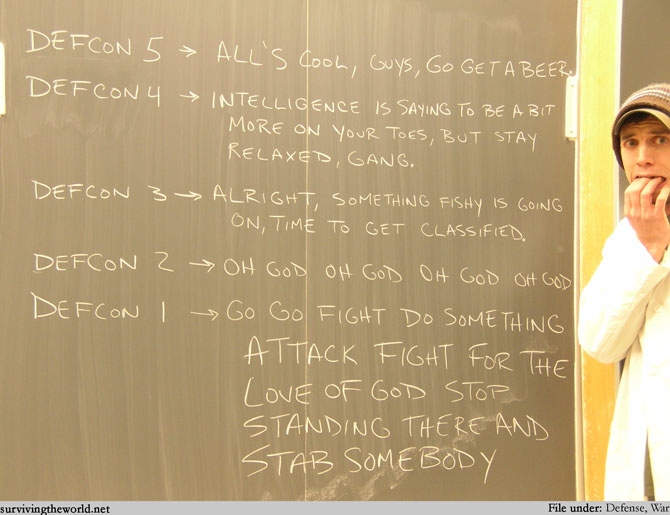 Some of it is helpful, some of it should not be applied practically by any sane individual, but the comics are generally pretty good. It's always fun to watch Dante's face in the sidebar, too, which can be anything from scared silly (above) to massively goddamn creepy (see link in title). Published every day, and usually early, it's a great way to get your humor fix in the mornings.
(By the way, folks, here's where the hipsterism starts; both these last two are entirely obscure.)
Webcomic #2: Daisy Owl
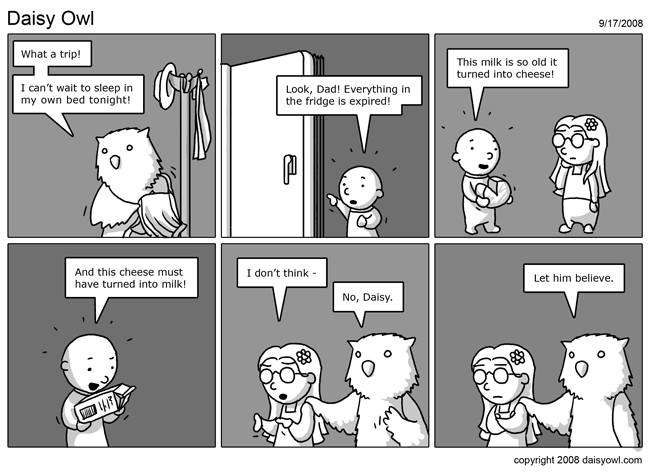 Sadly no longer running, Daisy Owl is still my second favorite webcomic because of its uniqueness. The strip didn't go for a punchline or an easy joke, preferring (much of the time) to try more offbeat humor or just plain ridiculousness. Example: The main characters are a bear, an owl and the owl's two human children. The children were originally space babies developed by the government, who were shot into orbit accidentally, crashed in Owl's backyard and were adopted by him.
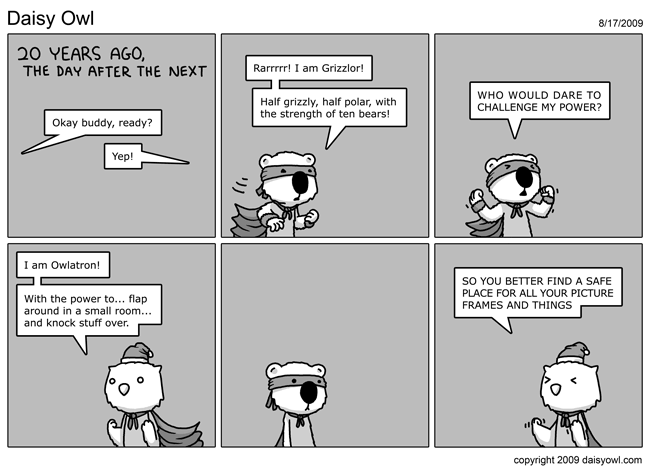 The art is sporadic; most of the comics are like the one above, with no backgrounds and lots of blank space, but every so often will come along this wonderfully detailed drawing extravaganza. The humor isn't for everyone, but I found it both really funny and really endearing. Sadly, the strip started feeling forced towards the end, and it shows in the last big storyline; the artist ended up stopping Daisy Owl because he was feeling the pressure of coming up with a new gag every few days. The early and middle of Daisy Owl, though, are excellent.
Webcomic #1: Freefall
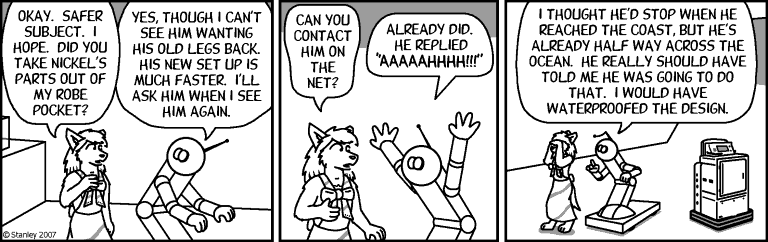
Let me tell you a little story about how I reacted when I found Freefall. The comic has been updating every three days since 199-freaking-9, giving it a massive backlog of comics (over 2,000 right now, for those scoring at home). The day I discovered it, I read all 2,000 comics in less than 24 hours.
Freefall is a science-fiction webcomic, combining the best elements of hard sci-fi (no "magic" technology, just extrapolating from what we already know) with excellent, detailed characters, original ideas and complex, intricate plots. The comic takes place on a world that's in the process of being terraformed, a sort of frontier existence. Many of the main characters are robots; others include a squid-like alien, a wolf/human hybrid A.I., and the occasional human. The development of the characters themselves has been fascinating to watch, but I've never seen a comic that gets inside the heads of non-human entities as well as this one does. They have realistic goals and desires, and worldviews that aren't just a human perspective grafted onto a robot body. This comic reads like the creator really did get inside the minds of some robots and give them their own unique perspectives, which is really incredibly rare.
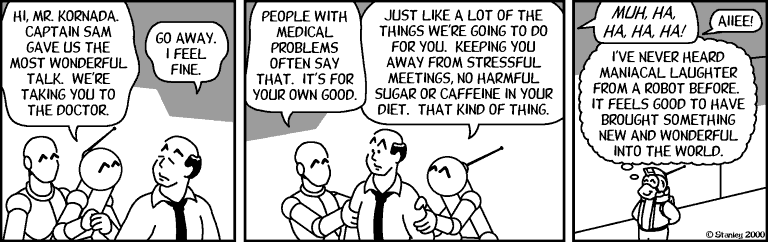
Now, the comic isn't perfect. Each strip covers only a fraction of a day or a conversation, and the strip attempts to mimic the lives of these characters as closely as possible. This means that in its twelfth year and its 2,000th strip, Freefall has advanced less than six months in in-comic time. Major plot threads will take a long, long time to resolve; the current plotline, which deals with stopping a robotic war, has lasted for a few months now and is still only in the exposition. Nevertheless, it's an extremely good webcomic that's hindered only by its formula, and contains dozens of distinctive and believable characters. Whether it's main characters Sam Starfall (squid), Helix (robot), Florence Ambrose (Bowman's Wolf) or recurring contributors like Qwerty, Dvorak, Sawtooth Rivergrinder, Edge, Blunt (robots) or even the occasional human (The Mayor, Mr. Konada, Winston Thurmad), every single one is a pleasure to read. I highly recommend plowing through the archives; you might be done sooner than you think possible.
Webcomic #6: Sandra and Woo!
 |
| They've helpfully put together a sample for new readers. Click to expand! |
Consciously inspired in part and influenced in large by Calvin & Hobbes, Sandra & Woo chronicles the adventures of a grade-school girl and her talking raccoon, as well as a coterie of her friends. The comic is a German/Indonesian collaboration between writer and artist, whose drawings are reminiscent of Japanese manga, but very technically detailed. The comic has periodic story arcs that'll last a dozen or a couple of dozen strips, which can be as lighthearted as exploring an abandoned building Final Fantasy-style, or as serious as a panegyric on human rights violations in Burma. I enjoy watching Woo (the raccoon) and his animal friends more than I do the humans in the comic, but the humans are still interesting and generally well-drawn. Woo isn't a sanitized Disney animal, either; as you can see in the first comic up above, he's frequently shown killing and eating prey. That isn't glossed over for younger readers, which I've always found appealing.
Now, it's not the greatest comic; the strip's FAQ tells us the writers have stopped focusing so much on Woo and Sandra since around fall '09, in favor of the human families of Sandra's friends, which I think is generally less interesting. That doesn't mean, however, that it isn't a very technically accomplished and very good comic.
Webcomic #5: Scandinavia and the World!
This is still funny, though. A Danish artist turned comic-strip writer created this comic, in which the characters are all personifications of countries, or rather the stereotypes of those countries. There's a lot of in-joking about Scandanavian stereotypes (the main characters are Sweden, Norway, Denmark and Finland), but Humon (the artist) always explains the jokes at the bottom of the page, which are sometimes funnier than the comic in question. The strip itself is funny, obscene at times and often devastatingly accurate in its characterizations, which aren't limited to Scandanavia. The USA frequently makes appearances as a well-meaning but immature dude (my favorite strip has him charging into Iraq while yelling "LEEEEEROOOOOYYY JENKINS!!!!!!"), and by this point most of Europe has also had cameos. The stereotypes Scandanavians apparently have about the U.S. tend to vary between puzzlingly wrong and devastatingly accurate.
By now, the strip has its own mythology, with lots of relationships between the various countries and even some children. The hilarious thing is that all of the relationships do have some bearing in either history or stereotypes. It's a little hard to keep track of if you don't know all of the various Scandanavian islands and principalities offhand, but that makes it no less fun to read.
Webcomic #4: Edmund Finney's Quest to Find the Meaning of Life!
Webcomic #3: Surviving the World
From creator Dante Shepard, STW is exactly what it sounds like: Little bits of wisdom about and commentary on the art of getting through life.
(By the way, folks, here's where the hipsterism starts; both these last two are entirely obscure.)
Webcomic #2: Daisy Owl
Webcomic #1: Freefall
Let me tell you a little story about how I reacted when I found Freefall. The comic has been updating every three days since 199-freaking-9, giving it a massive backlog of comics (over 2,000 right now, for those scoring at home). The day I discovered it, I read all 2,000 comics in less than 24 hours.
Freefall is a science-fiction webcomic, combining the best elements of hard sci-fi (no "magic" technology, just extrapolating from what we already know) with excellent, detailed characters, original ideas and complex, intricate plots. The comic takes place on a world that's in the process of being terraformed, a sort of frontier existence. Many of the main characters are robots; others include a squid-like alien, a wolf/human hybrid A.I., and the occasional human. The development of the characters themselves has been fascinating to watch, but I've never seen a comic that gets inside the heads of non-human entities as well as this one does. They have realistic goals and desires, and worldviews that aren't just a human perspective grafted onto a robot body. This comic reads like the creator really did get inside the minds of some robots and give them their own unique perspectives, which is really incredibly rare.
Now, the comic isn't perfect. Each strip covers only a fraction of a day or a conversation, and the strip attempts to mimic the lives of these characters as closely as possible. This means that in its twelfth year and its 2,000th strip, Freefall has advanced less than six months in in-comic time. Major plot threads will take a long, long time to resolve; the current plotline, which deals with stopping a robotic war, has lasted for a few months now and is still only in the exposition. Nevertheless, it's an extremely good webcomic that's hindered only by its formula, and contains dozens of distinctive and believable characters. Whether it's main characters Sam Starfall (squid), Helix (robot), Florence Ambrose (Bowman's Wolf) or recurring contributors like Qwerty, Dvorak, Sawtooth Rivergrinder, Edge, Blunt (robots) or even the occasional human (The Mayor, Mr. Konada, Winston Thurmad), every single one is a pleasure to read. I highly recommend plowing through the archives; you might be done sooner than you think possible.
Subscribe to:
Posts (Atom)