If you somehow missed the Babylon 5 rumpus that's been taking place around here for the past week, fear not: all the links can be found right exactly here. Last Friday, I did an overview of the show. Monday was the show's best characters, Tuesday was its worst, Wednesday was its best aspects and Thursday and Friday covered its worst aspects. Today, we wrap up the whole thing.
It occurred to me while I was writing the 'worst things' posts that I might be grading Babylon 5 on an unfair metric. Comparing B5 to the three best sci-fi shows of the 2000s--Battlestar Galactica, Doctor Who and Firefly) inevitably puts it at a disadvantage, and there are all kinds of mitigating circumstances relating to why it stinks at times. Its first four seasons aired on a network (PTEN) that was relatively unknown and probably doomed from its inception, its budget was poor, it was in an era of TV sci-fi that didn't have all that many standout shows, and so on. The best sci-fi shows of the 2000s benefited from ample budgets, well-known networks and better actors than B5 could muster.
I'm not so sure that's an excuse, though. Less than two decades after its release, Babylon 5 looks extremely dated. The bad CGI, the heavily made-up cast contribute to it and the pre-HD cameras contribute to it, but there's a certain look to the footage, sets and in the directing that just stamps the show as old-fashioned. (The camera basically remains at shoulder height for the entire series.) It gained a large cult following and is remembered fondly by many sci-fi fans, but against sleeker, more modern shows it just doesn't measure up.
Ultimately, it's hard to pin the show's faults on J. Michael Straczynski or on extenuating circumstances. The actors are wooden, the directing is ordinary and the dialogue is poor: is that Straczynski's fault, or was it the fault of the era? It's hard to prove one way or the other. Ultimately, though, the only real criteria upon which I can evaluate Babylon 5 is how it looks to me, a fan of sci-fi that came of age in the 2000s.
Viewed purely on its own merits, then, Babylon 5 falls short in most ways. As I've been saying throughout this weeklong review, the show is consistently mediocre. Straczynski often likened his creation to a novel, but it's not an exciting one if that's the case. Bad writing, a lot of bad acting, bad casting, bad set design and stories that took forever to tell drag this show down, and good acting, some good universe-building and a pair of good seasons resuscitate it. I think some of the show's appeal originally lay in its serialization and consistent mediocrity: you could turn on the TV every week and know what you were getting. It wasn't going to be more than occasionally good, but it wasn't going to be horribly bad either, perhaps because there was so little at stake.
If you're a fan of the shows I mentioned at the start of this post, Babylon 5 is probably not for you. It's not remotely in their league. If your standards are lower or you're a fan of '90s sci-fi, then give it a try.
More Or Less Arbitrary Grading Scale
Acting: B-
Set Design: D
Character Development: A-
CGI: D-
Average Episode Quality Relative to Itself: C
Imagination: B
Writing: D+
Universe-Building: A-
Good Villains: C- (good in seasons 2 and 3, terrible in 4 and 5)
Good Heroes: D-
Good Characters Who Are Both: A
Series Ending: F
Arc Continuity: A
Character Continuity: D+
OVERALL SERIES GRADE: C-

Showing posts with label j. michael straczynski. Show all posts
Showing posts with label j. michael straczynski. Show all posts
Saturday, August 13, 2011


Friday, August 12, 2011
The Worst Aspects of Babylon 5 (Part 2)
We're nearing the end of the Babylon 5 blitz. In case you missed the deluge of B5-related posts over the past week, here are some links: last Friday's overview of the show, Monday's rundown of the best characters, Tuesday's rundown of the worst characters, Wednesday's 'Best Aspects of B5' and Thursday's 'Worst of B5, Part 1'. Today I'll have Part 2 of the Worst Things, and then we'll wrap everything up on Saturday.
“The thing that makes the current B5 conflict so uninteresting to watch is the absolute moral battle lines that have been drawn. Sheridan is what they call a paragon of virtue, a perfect ideal. He stands for Truth, Justice and the American Way, all in capital letters. ______'s side stands for nothing but fucking up other peoples’ shit. There’s no moral conflict because it’s been spelled out in the most explicit terms. Plus, there’s no documentation of what ______ does, how he does it or why. We don’t know how he got to be a police state-type of fellow, we’ve barely met him. We don’t know how he keeps everyone in line, other than through misinformation.
“There’s just such absolute ideological superiority from Sheridan, who sounds like a horse’s ass every time he draws upon it. There are very few moral choices or ambiguities to be found in B5.”
This is part of what I was saying about Sheridan, Zack Allan and Dr. Franklin in the Bad Characters post. They are so morally upright and the villain (in this case especially) is so poorly defined, it makes them unbelievable. There are very few moral conflicts on this show, and most of them feel manufactured (like the one near the end of Season 4 with the telepaths). The only convincing one comes at the end of Season 3, where Sheridan holds Morden against his will. For the rest, nothing. Sheridan and Co. are always right and the other guy is always wrong, period, end of line. This is especially true of the Season 4 villain, an evil cardboard cutout that we almost never see on-screen.
The point here is that nobody really seems like an expert at their job, the way Chief Tyrol is an expert Viper repairman (Battlestar) or the way Wash is a special pilot (Firefly). They don’t have to say ‘I’m competent at my job’, we see them demonstrate their competence. In B5, nobody seems to be that skilled at any job. The emphasis is on having the right people and the right personalities, not their skills, which I find strange.
Something traumatic happens to Garibaldi in Episode A. The episode ends, the threat is dealt with and Garibaldi goes back to work. Several episodes go by, during which Garibaldi seems unchanged. Then in episode H, Garibaldi has a nervous breakdown and goes “I’ve been haunted by the vision of my wife’s buttocks ever since Episode A!!”
This happens ALL THE TIME. A character has a crisis, then seems totally fine, then tells us that they haven’t been fine all this time, even though they’ve been acting totally fine. I don’t know what to attribute it to, but it’s really lousy continuity between episodes. It feels like the show wants to have the emotional continuity of a Battlestar Galactica, but doesn’t really know how to go about it. This results in a lot of unintentional comedy, as characters have massive freakouts over something they were totally okay with just last episode.
-Straczynski’s enormous plot arcs move maddeningly slowly, although this shouldn’t be unfamiliar for recovering Lost fans like myself.
-Because we rarely leave the station in the first two seasons, it’s hard to get a sense of the greater outside universe. This does change in seasons 3-5, as more of the characters venture outside, but it’s a little off-putting early on.
- B5 tells, it doesn’t show, particularly with regard to characters’ emotions. Straczynski doesn’t let the actors show you how the character is feeling, he writes in huge info-dumps where the character tells you exactly how he feels today.
The Writing Stinks
I’ve been dancing around this for awhile, but I’ll just say it: The writing, done almost entirely by J. Michael Straczynski, is consistently bad. It is full of clichés, the dialogue isn’t clever (there’s a fascination with light bulb jokes that goes on for way too long), it’s fairly humorless and it doesn’t make you feel for the characters. The best thing you can say about the writing is that it gets the job done and tells you what you need to know in a given episode. The worst thing you can say is that’s all it does. The writing isn’t My Immortal-bad, but it’s serviceable at best. Compare it to Battlestar or Doctor Who or Firefly or even Star Trek and you’ll see what I mean. It’s a handicap to the actors rather than a help. Consequence: Moral Superiority and Lousy Villains

I wrote the following halfway through Season 4:
“The thing that makes the current B5 conflict so uninteresting to watch is the absolute moral battle lines that have been drawn. Sheridan is what they call a paragon of virtue, a perfect ideal. He stands for Truth, Justice and the American Way, all in capital letters. ______'s side stands for nothing but fucking up other peoples’ shit. There’s no moral conflict because it’s been spelled out in the most explicit terms. Plus, there’s no documentation of what ______ does, how he does it or why. We don’t know how he got to be a police state-type of fellow, we’ve barely met him. We don’t know how he keeps everyone in line, other than through misinformation.
“There’s just such absolute ideological superiority from Sheridan, who sounds like a horse’s ass every time he draws upon it. There are very few moral choices or ambiguities to be found in B5.”
This is part of what I was saying about Sheridan, Zack Allan and Dr. Franklin in the Bad Characters post. They are so morally upright and the villain (in this case especially) is so poorly defined, it makes them unbelievable. There are very few moral conflicts on this show, and most of them feel manufactured (like the one near the end of Season 4 with the telepaths). The only convincing one comes at the end of Season 3, where Sheridan holds Morden against his will. For the rest, nothing. Sheridan and Co. are always right and the other guy is always wrong, period, end of line. This is especially true of the Season 4 villain, an evil cardboard cutout that we almost never see on-screen.
I’m Sorry… You Do What Now?
B5 relentlessly hammers home the theme that its characters are special people. There’s an entire Season 2 episode devoted to making sure that Sheridan and Delenn are the right people in the right place at the right time. But on the level of their jobs, they never seem to have much expertise. This is a minor quibble, but what does Garibaldi do exactly? He’s a good shot and he knows how to ask questions, but he doesn’t possess any skills specific to being a Security Chief. Dr. Franklin lets machines do all the work for him, is rarely seen in surgery and operates as a glorified diagnostician. Everything from mission-critical research to flying starfighters is handled by omnipresent computers.  |
| picture unrelated. |
You Had A Problem? Since When?!
Here’s a fairly typical scenario:Something traumatic happens to Garibaldi in Episode A. The episode ends, the threat is dealt with and Garibaldi goes back to work. Several episodes go by, during which Garibaldi seems unchanged. Then in episode H, Garibaldi has a nervous breakdown and goes “I’ve been haunted by the vision of my wife’s buttocks ever since Episode A!!”
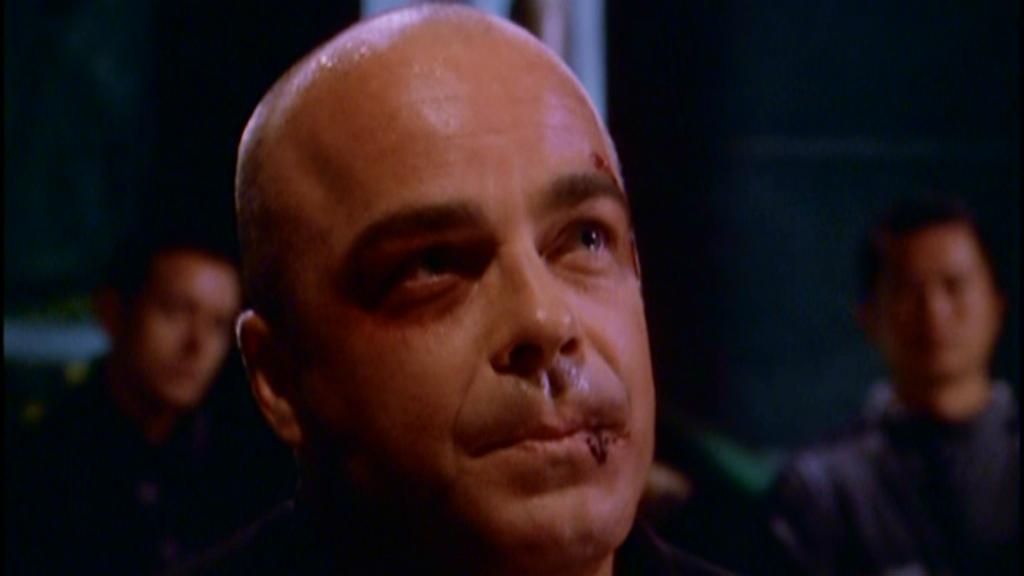 |
| Seconds before bursting into incoherent rage. |
In The Conversation:
-The music isn’t very good or very memorable, and it’s kind of used as a blunt instrument. You know exactly how you’re supposed to be feeling because the violins tell you it’s an emotional moment. -Straczynski’s enormous plot arcs move maddeningly slowly, although this shouldn’t be unfamiliar for recovering Lost fans like myself.
-Because we rarely leave the station in the first two seasons, it’s hard to get a sense of the greater outside universe. This does change in seasons 3-5, as more of the characters venture outside, but it’s a little off-putting early on.
- B5 tells, it doesn’t show, particularly with regard to characters’ emotions. Straczynski doesn’t let the actors show you how the character is feeling, he writes in huge info-dumps where the character tells you exactly how he feels today.
Not Bad, Just Weird:
For some reason, whenever a character has a minor wardrobe change, it’s made into a big honking deal in the show itself. Sheridan’s beard, Delenn’s hair, the new B5 uniforms, Security uniforms, G’Kar’s eye color, etc. are all played up much more than you’d imagine them being. It’s not a bad thing, just a quirk.
Thursday, August 11, 2011
Mayhem Week: The Worst Things About Babylon 5 (Part 1)
Welcome to the week-long review of the TV show called Babylon 5! In case you missed 'em, here are links to last Friday's introduction to the show, Monday's 'Best Characters', Tuesday's 'Worst Characters' and Wednesday's 'Best Aspects of B5' posts. Tomorrow we'll have Part II of 'Worst Aspects', and then I'll wrap everything up in Saturday's post.
That Confounded Bad Acting
Kindly check Tuesday's post for a discussion of said bad acting.
Humans in Suits
Early in the show’s run, creator J. Michael Straczynski made the decision to eschew CGI aliens in favor of human-looking aliens. The choice was a sensible one, because the CGI of the mid-1990s looks awful, especially on a Prime-Time Entertainment Network budget. There’s some sort of Centauri-world bloodsucking thing in Season 1 that proves this particular point. Putting guys in makeup, therefore, was a logical decision.

The problem with this is twofold. One, nobody ever gives any reasons why the Minbari have bony heads, or why the Narn are orange, or why the pak’ma’ra have facial tentacles. They don’t serve any obvious function, so right from the start they feel like semi-random ornamentation. Two, even if the actors look like humans wearing makeup, there’s always the possibility that their bodies are more alien than they look, but this idea is systematically stamped out over the course of the series.
It’s established that the majority of the ‘aliens’ speak English without trouble, have five fingers, four limbs, bipedal movement, two eyes that see in the human visual spectrum, breathe a nitrogen-oxygen mix, have approximately the same physical strength and vulnerabilities that humans do, think the same way that humans do, and are comfortable with Earth ‘standard’ gravity. This strains one’s credulity a bit far, don’t you think? (The First Ones that we meet are all nonhuman, but they are seen far less often than the human-esque races, probably due to budget constraints.)
I Mentioned the CGI…

I feel kinda bad putting this on here, because it’s really not the fault of the creators. They had in mind a very CGI-heavy show, with lots of space battles and expeditions, and mid-1990s CGI was both expensive and godawful. YouTube videos are better nowadays. But they went ahead with it anyway, and so while the CGI is worse than anything else you will ever see on TV, it’s also a testament to the show’s creative spirit. Hey, I guess that sort of turned into a good thing, huh?
Even the Real Sets Stink
Chalk another one up to a presumable PTEN budget crunch. It seems like a weird thing to criticize, but you know how in Firefly, the characters had a real connection and identification with the ship? How in Battlestar Galactica, the ship is a prison, a symbol and a source of hope all in one? How both ships really have personality and feel like home for their characters?
B5 doesn’t have that. It sounds picky, but the sets are clunky and featureless and boring. There’s really not much effort to sell the station as someone’s home, as opposed to ‘where alien races meet to hang out’. This holds for all the sets, whether they’re on Mars or on Minbar or on the bridge of some ship somewhere. They don’t look remotely real, and more importantly, they don’t feel real. The actors don’t treat them like they’re real places. It’s like they took one of the worst lessons from Star Trek. (Small exception: the Drazi homeworld, which we visit in Season 5, is incredibly compelling.)
I Saw That Coming
If someone on B5 mentions that Garibaldi must be having a great time on vacation on Zogblog VII, you can take it to the bank that the next shot will be of a bloody, bruised Garibaldi gasping for air. It’s a fairly predictable show. I’m not going to give away anything, but there’s a particular event in early Season 4 that is meant to be a huge surprise, but it’s just completely unsurprising. Even Season 5 is guilty of this. The viewer can predict B5 without too much effort, and the show doesn’t really make you think. That, to me, is pretty damning.
Speaking of S5…
 |
| Huh? |
I like Season 5 the best of all of the Babylon 5 seasons. Like I said before, they get decent acting out of Jeff Conaway and Patricia Tallman, introduce some good guest-stars and have some really great universe-building episodes. But the season itself was spectacularly mismanaged.
Due to a flash-forward in Season 3 and a brief scene at the end of Season 4, the viewer basically knows all the important points about one of the major threats of season 5. I was waiting around for eighteen episodes while the characters stumbled around with this threat, going “I know this! I know this one, dammit! Figure it out!” And when they finally do catch on to what the viewer could see eighteen episodes ago, is there a showdown? Is the evil defeated? No! That storyline and a half-dozen others are intentionally punted, left to be resolved in made-for-TV movies and the spin-off series, replaced by four episodes’ worth of characters saying their goodbyes! I think that’s a total waste of a season. Wikipedia revealed that there was a lot of confusion with the demise of PTEN and the creators not knowing whether their show would be picked up (it was, by TNT, for Season 5), which might be a root cause of the fractured season. I get that, I do, but surely they could have done better than that. It would be like Battlestar Galactica declining to reveal the fifth member of the Final Five Cylons, wagging its finger at the fans and saying “Uh-uh-uh! You have to watch Caprica to get your answers! C’mon, I’m gonna string you guys out for ALL of your attention span!”
Tune in tomorrow for more embarrassing flaws in the show!
Wednesday, August 10, 2011
The Best Aspects of Babylon 5
Good afternoon! If you're just tuning in, we're midway through a weeklong super-review of the TV show Babylon 5. Last Friday's preview of the show can be found here, Monday's post on B5's best characters here, and Tuesday's description of the worst characters here. Today, we tackle the best things about the show. Thursday and Friday will be posts about the worst things, and then we'll wrap it all up on Saturday.
 B5’s cast, while accomplished, can’t compare to the David Tennants and the Nathan Fillions and the Edward James Olmoses of the world. It’s full of duds, including some of their biggest ‘stars’, and a lot of those duds’ on-screen time is a total waste of your patronage. But, surprise surprise, they have a lot of good actors/actresses putting in time as well. Peter Jurasik and Andreas Katsulas are golden whenever they’re on screen, and both get a ton of time and storylines in all five seasons.
Aside from Lennier, Ivanova and the frequent guest stars I just mentioned, B5 brings in dozens of outside names every season. I can’t think of an episode that didn’t feature at least one one-off or recurring guest star, and a lot of the time it’s pretty effective. Wayne Alexander, who plays several of these roles, was a recurring favorite of mine.
 Like I said in the beginning, the series is primarily composed of mediocre episodes, but every now and again comes a spectacular one. Babylon 5 doesn’t futz around with time travel much, but those episodes are some of the best. The culmination of the Shadow War in Season 4 is a kick-ass episode, as are a number of episodes in Seasons 1 and 5 (the Jewish one in S1, the fighting one in S1, the one in S5 where Garibaldi and Lochley bonk heads, etc). If you have the patience to sift through the crap, there’s some gold underneath.
I’m fine with that formula. But once or twice a season, the creators would try something completely different. It could be a news report on the state of the station, or following around random maintenance workers we’d never seen before, or taking a snapshot a million years in the future. All of these episodes served as a welcome change of pace, and most of them were pretty darn good.
 This is my favorite of the good things, and just about the only thing B5 has that sets it apart from the rest of TV sci-fi. You know how in Doctor Who, there’s a sense of the future being wide-open and full of wonders and practically infinite? Babylon 5 does a similar thing with the past. It has a wonderfully pervasive sense of age, of ancient wonders and fallen species and a history that far predates human experience. Any show can say that there’s been civilization millions of years in the past, but Babylon 5 makes you feel that sense of age and the unknown, of ancient mysteries and hidden treasures. That, I feel, is B5’s most distinctive and best feature.
Good Acting

Aside from Lennier, Ivanova and the frequent guest stars I just mentioned, B5 brings in dozens of outside names every season. I can’t think of an episode that didn’t feature at least one one-off or recurring guest star, and a lot of the time it’s pretty effective. Wayne Alexander, who plays several of these roles, was a recurring favorite of mine.
Racial Psychologies
This is primarily a Season 1 and 2 thing, but one of Straczynski’s better moves was giving each major species its own background and personality, and having them manifest through that species’ ambassador on B5. Londo dreams of the vanished days of his once-great Republic, and sets horrible plans in motion based on those dreams. G’Kar’s race was repressed by Londo’s, and his species is still looking for its place in the universe. That’s evident in Katsulas’s acting. A lot of the humans are veterans of the Minbari War, a war they only won when the Minbari surrendered (they were about to win), and they’re still visibly freaked out about it. It's good casting, acting and writing all together.The Big Ones

Season 1, Season 5
In fact, those might be the show’s two best seasons. Season 1 featured Michael O’Hare instead of the wooden Bruce Boxleitner, and Season 5 got a lot of things right that hadn’t worked previously. It expanded some characters’ roles and scaled back others, gave Lyta Alexander a personality and introduced Robin Atkin Downes (“Lord” Byron) and Tracy Scoggins (Elizabeth Lochley). It’s perhaps an indictment of Straczynski’s inflexible arcs that his show’s best seasons were largely free of the series’ two longest-running storylines, but what can you do? Babylon 5 was best when it was universe-building, and that made up the meat of S1 and S5.The Offbeat Episodes
Most of the B5 episodes followed a pretty specific formula. Station is hanging out, outside force/person/technology enters the station, someone wants to capture/speak to/negotiate with said force/person/tech, mayhem ensues. According to Wikipedia, Straczynski’s ideal show differed from the Star Treks of the time by having the universe come to the station, not having the station go and explore the universe. I’m fine with that formula. But once or twice a season, the creators would try something completely different. It could be a news report on the state of the station, or following around random maintenance workers we’d never seen before, or taking a snapshot a million years in the future. All of these episodes served as a welcome change of pace, and most of them were pretty darn good.
A Bigger, Older Universe

Tuesday, August 9, 2011
The Worst Characters of Babylon 5
Brief introduction: this week I will be doing an extended review of the TV show, Babylon 5. For last Friday's preview/series basics, click here. For yesterday's overview of B5's best characters, click here.
John Sheridan (Bruce Boxleitner), Captain of Babylon 5
John Sheridan (Bruce Boxleitner), Captain of Babylon 5

Yep. Their flagship actor, Bruce Boxleitner (fresh off a lead role in Tron), is just awful in B5. There’s nothing distinctive about him. He’s a leader, he’s able to build consensus and he’s irreplaceable in B5 politics, but the guy himself would fit comfortably into any good guy/leader role. In fact, you could probably swap out not just Boxleitner, but the entire character of John Sheridan with any other generic good guy/leader and not notice the difference.
Sheridan has no flaws. None. Seriously, go back and watch the series like I did, and tell me if you find one single character flaw. The worst thing he does is display loyalty to his dead wife. How exactly are viewers supposed to relate to a flawless character? Boxleitner’s acting is poor (he reminds me of George Washington’s face on Mount Rushmore) and the character is a total write-off. We are given countless opportunities to know, meet and understand Sheridan, and it’s not like they didn’t try to write in depth for him. We’re given insight into his minutest thoughts, quirks and habits, and given every opportunity to like both actor and character. It just doesn’t work at all.
Zack Allan (Jeff Conaway), Asst. Security Chief of Babylon 5
Zack Allan (Jeff Conaway), Asst. Security Chief of Babylon 5

A bit-part character in Season 2 who ascends to a starting role in seasons 3-5, Zack Allan probably should have stuck to occasional guest appearances. He's even less watchable than Sheridan, and Conaway's acting is worse even than Boxleitner's. Zack starts to show some emotion midway through Season 5, but that’s about all you can say for him. The guy is a featureless rock with a stupid accent who does nothing worthwhile on the show. Londo pegged him perfectly with the caustic line, “You have that vacant look that says, ‘Hold my head to your ear. You will hear the ocean.’”
Stephen Franklin (Richard Biggs), Chief Medical Officer of Babylon 5
Stephen Franklin (Richard Biggs), Chief Medical Officer of Babylon 5

For the third entry in a row, the character is uninteresting and the actor is poor. Biggs, Conaway and Boxleitner are given different qualities of material to work with, but all of them stink up the joint. Biggs just doesn't bring anything to the party in terms of acting ability, and his character suffers as a result, despite being given all sorts of material to work with. I didn’t always think this of Franklin; he handles a difficult science-versus-religion episode well, and is featured in the series’ most Star Trek-esque episode early in Season 1. But his emotionless patter, terrible delivery and lack of depth do him in. There is honestly a whole sub-arc in Season 3 whose sole purpose is to give Franklin some personality. After it’s over, Franklin picks himself up, dusts himself off and goes right back to being the same dull, featureless person he was pre-arc.
(Note: These three are highly visible, often-seen members of the B5 command staff. A lot of the good characters, many though they be, are stuck in more seldom-seen roles. Lennier is a minor character, Bester and Morden are occasional guest stars, etc. So although there are fewer of these guys, their crappiness has a disproportionate effect on the show at large.)
Virini (Damian London), Chamberlain to the Centauri Court
(Note: These three are highly visible, often-seen members of the B5 command staff. A lot of the good characters, many though they be, are stuck in more seldom-seen roles. Lennier is a minor character, Bester and Morden are occasional guest stars, etc. So although there are fewer of these guys, their crappiness has a disproportionate effect on the show at large.)
Virini (Damian London), Chamberlain to the Centauri Court

You have never met a more annoying character than Chamberlain Virini. He is fluttery, he is flighty and he is unconscionably stupid. You know those characters in anime franchises who are constantly behind on the plot, rarely to never understand what’s happening around them and run around screeching like demented geese whenever anything changes? Damian London is the live-action version of that, and it’s somehow even more annoying in this medium. London does a little better when he’s asked to be creepy in Season 5 (a lot of things improve in Season 5), but the rest of the time he’s just awful. I guess that’s just the role he was asked to play, in which case, this is the only time you’ll hear me criticize an actor for doing his job too well.
In the conversation:
In the conversation:
Lyta Alexander (Patricia Tallman), Emperor Cartagia (Wortham Krimmer), David Corwin (Joshua Cox), President Clark (Gary McGurk). Tallman was ordinary in three seasons before blossoming in Season 5, when she was given an expanded role and more screen time. Krimmer wasn’t bad; his presence here is because he served as a walking reminder that you were watching a TV show. “How did someone so brain-twistingly insane become Emperor anyway? Oh, because it's on TV and someone has to be the villain.” McGurk I’ll deal with in the “Bad Things” note. As for Corwin, he’s here more as an indictment of creator J. Michael Straczynski than anything else. The guy appeared in 34 episodes as a member of the bridge crew, and in only one does he have significant lines or a subplot of his own. They could’ve done a lot more with him.
Subscribe to:
Posts (Atom)